Beads Out
- 4.6
- Rating
- 1.00M
- Installs
- Free
- Price

 Analysis by App-foxy
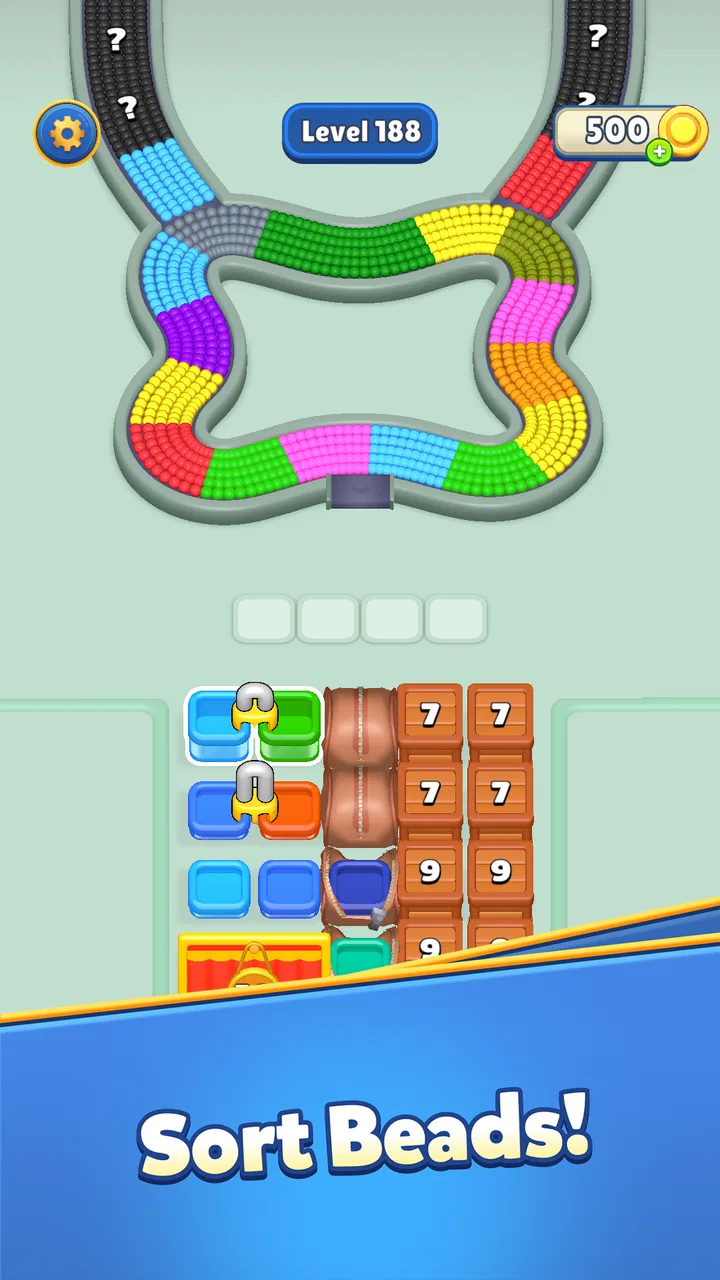
I like puzzle games that explain themselves before I have time to get comfortable. Beads Out aims for exactly that kind of instant understanding: the play area is built around a conveyor, and my job is to collect the balls moving through it. The idea is easy to grasp, but the appeal comes from turning that simple task into a sequence of quick decisions. I can open it when I have only a spare moment, understand what is happening immediately, and start playing without learning a long rule set.
That makes it a natural fit for short sessions rather than a game I would plan an evening around. It is a free puzzle game from VOODOO, and its store summary, “Collect the balls from the conveyor!”, accurately points to the central interaction without pretending there is a complicated story behind it. I found the strongest reason to try it in that directness: Beads Out does not ask me to memorize characters, manage a large inventory, or follow a demanding campaign before the fun begins.
Why the first few moments work so well
The opening appeal is visual and practical. A conveyor gives the puzzle a sense of movement, while the balls provide an obvious target. Even without a detailed tutorial, the relationship between the moving objects and the goal is straightforward. That matters when I am playing during a coffee break or while waiting for an appointment, because I do not want to spend the first minute decoding menus or reading instructions.
You May Also Like

 Blood Strike: 2.5 Anniversary
Blood Strike’s Loadouts Turn Every Drop Into a Tactical Gamble
A close look at Blood Strike’s custom loadouts: how fast access to signature weapons reshapes its battle royale rhythm, rewards preparation, and narrows the gap between fights.

 Pandora - Music & Podcasts
Pandora’s Music Is Easy to Start, but Harder to Recover
Pandora’s strength is its low-effort path from a seed to a station. Its weak spot is how much confidence it asks you to place in connection, setup, and quiet recovery.

 8 Ball Pool
 Is Built on Rivalries, Rematches, and Routine
A close look at the rivalries, rematches, shared routines, and unanswered safety questions that turn a quick pool match into a persistent mobile community.

 Samsung Music
’s Quiet Strength Is Playing What You Already Own
Its reach comes less from spectacle than from dependable access to a personal library. That simplicity is both the app’s strongest retention engine and its ceiling.

 AccuWeather: Weather Radar
AccuWeather Review: A Quick, Clear Forecast for Everyday Decisions
For everyday plans, the best forecast is the one you can understand quickly. AccuWeather makes rain timing, radar, and local conditions easy to act on, with a few trade-offs.

 Hill Climb Racing
Why Hill Climb Racing Still Turns Crashes Into One More Run
A tiny car, a bumpy hill and one more upgrade: Hill Climb Racing keeps resurfacing because its simple chaos makes every near-miss feel personal.
More From Our News Desk



The game belongs firmly to the casual puzzle space, but it is not simply a static matching board. The moving conveyor creates a small amount of urgency. I have to pay attention to what is arriving, decide what deserves attention first, and avoid treating every moment as interchangeable. The pleasure is less about solving a grand mystery and more about keeping a simple process under control.
I also appreciate that the concept leaves room for visual satisfaction. Collecting objects from a moving line can feel tidy and rewarding when the board begins to clear. That kind of feedback is especially effective in a mobile game because it gives a small sense of completion even when I have played for only a short time. The best sessions are the ones where I can see the situation becoming more manageable as a direct result of my choices.
There is a useful distinction here between understanding the objective and mastering the rhythm. I know what I am supposed to do almost immediately, but that does not automatically mean every decision feels equally safe. The conveyor keeps the board active, so I cannot rely only on slow inspection. This is where the game earns its puzzle label rather than feeling like a simple tapping exercise.
A rhythm built for interruptions
My favorite quality is the compact session rhythm. Beads Out is easy to pick up, and its central action does not require a long emotional or narrative commitment. If I have a few minutes before leaving home, I can play without worrying that I am abandoning a complicated mission halfway through. That makes it more practical than many puzzle games that expect a level to receive uninterrupted attention.
It works particularly well in everyday situations where my focus is limited. Imagine standing in a checkout line, riding as a passenger, or waiting for a meeting to begin. I can start a round, concentrate on the conveyor, and stop when the moment ends. The game’s immediate premise is an advantage in those situations because I do not need to reconstruct a story or remember a web of objectives when I return.
That does not mean every interruption is harmless. A moving puzzle naturally rewards attention, and looking away at the wrong time can leave me less certain about what changed. I would not choose it while walking, cooking, or doing anything that requires regular visual awareness elsewhere. The short-session design makes it convenient, but it does not turn active play into background entertainment.
For me, the best approach is to treat each launch as a small concentration exercise. I play for a brief stretch, focus on the current arrangement, and stop before the interaction becomes automatic. This keeps the conveyor feeling like a live part of the puzzle instead of visual noise. It also prevents the game from becoming something I operate without really thinking about.
How it feels when I return after a break
One question I would ask before installing a mobile puzzle is whether I can return without paying a mental tax. Beads Out scores well here because the basic objective is memorable. I do not need to remember a plot twist or a chain of complicated instructions. Seeing the conveyor and the balls is enough to remind me what kind of attention the game wants.
The practical benefit is that the game can fit around an uneven schedule. I can play once in the morning, leave it alone, and come back later without feeling that I have lost the thread. That is a meaningful strength for people who use games as small breaks rather than as their main hobby. The design is approachable enough that returning feels like resuming a familiar task, not restarting a study session.
Still, the return experience depends on how much progress a player expects from a session. Someone who wants every launch to deliver a major new discovery may find the premise too modest. The game’s reset value comes from repeating the act of reading the moving board and making better choices, not from a large narrative reveal. I would recommend it to players who enjoy refining a simple process, not to anyone looking for a deep world to uncover.
There is also a useful way to play when I know I may be interrupted: I avoid making a move just before putting the phone down. In a conveyor-based puzzle, the timing around a decision matters more than the few seconds saved by rushing. Waiting for a clearer moment can make a short session feel calmer and reduces the frustration of returning to a board that changed while my attention was elsewhere.
The pleasure of repetition—and its limit
Beads Out gets its replay value from a narrow but understandable loop. I return to the conveyor, read the current arrangement, collect what I can, and try to handle the next situation more cleanly. That loop can be satisfying because the rules stay accessible while my awareness improves. I begin to notice not just what is available now, but how a choice may affect the space that follows.
This is one of the game’s more interesting trade-offs. A focused mechanic is easier to enjoy in short bursts, but it also gives the experience fewer directions to expand. If I already know that I prefer story-driven puzzles, elaborate logic systems, or a wide range of distinct modes, this may feel too concentrated. Beads Out is at its best when the act of clearing and organizing the moving objects is enough motivation by itself.
I would not measure its replay value only by how long I can keep playing in one sitting. Its better measure is whether I am happy to revisit it later. For a quick mobile puzzle, that is a reasonable standard. The game can serve as a palate cleanser between more demanding activities, especially when I want a task with a clear beginning and a visible result.
On the other hand, repetition can expose the limits of a minimalist concept. Once the initial novelty of the conveyor has faded, the player needs to enjoy the underlying decisions rather than depend on surprise. I found that the game is more appealing when I approach it as a small skill loop. If I expect constant novelty, I am more likely to notice the compact scope.
A useful personal rule is to stop after a satisfying run instead of continuing until the interaction feels dull. That preserves the immediate pleasure and makes it easier to want another session later. This is not a game I would use to fill an entire afternoon by default; it is better as a repeatable pocket activity that gives me a clean mental reset.
Where it fits among other mobile puzzles
Compared with a traditional crossword or word puzzle, Beads Out asks for more visual tracking and less language. That makes it friendly to players who want a puzzle they can understand without reading much, and it also suits moments when I want to react to a changing board rather than sit with a clue. Compared with a match-three game, its conveyor focus gives the action a more process-oriented feel: I am managing movement and collection instead of simply searching for identical pieces.
It is also different from slower logic games that reward examining a fixed grid for a long time. The conveyor introduces a gentle pressure to stay engaged. If I prefer careful planning with unlimited time to inspect every option, another puzzle style may be a better fit. If I enjoy watching a system move and making timely choices, this game has a clearer advantage.
Compared with large puzzle adventures, the trade-off is obvious. Beads Out is easier to enter and easier to leave, but it offers less of the sense of place, progression, and discovery that comes from a substantial campaign. I would choose it over those alternatives when I want immediate play. I would choose the larger game when I want a longer-term project with more variety and a stronger sense of destination.
The developer’s approach is recognizable in the clean, direct premise associated with VOODOO’s casual catalogue, but I would not install this expecting a broad collection of unrelated activities. The appeal is the focused conveyor challenge. That focus is a strength for quick use and a limitation for players who need constant structural change.
Practical details before installing
The game is free to download, which makes trying it straightforward. It includes in-app purchases ranging from $1.99 to $99.99 per item, so I would check the purchase flow carefully before handing the phone to a child or letting someone else play on my device. The free entry point is useful for testing whether the central loop suits me, while the optional spending range is worth keeping in mind if I prefer games with no temptation to buy extras.
Its content rating is Teen, so I would not treat it as an automatic choice for very young children simply because the concept looks colorful and uncomplicated. Parents should use the device’s own purchase controls and review the game together before allowing unsupervised play. For older players, the rating is a reminder to consider the full mobile experience rather than judging it only by the simple ball-collecting premise.
Compatibility is reasonably broad for Android users: the current version is 2.2.6 and requires Android 8.0 or later. That makes checking the operating system the first practical step before installation. The game has passed the one-million-install mark, and its average rating is 4.1 from around eight thousand ratings, which suggests a solid level of interest without making it seem universally perfect.
Those figures match my overall impression: this is an accessible game with a clear audience, not a puzzle that will satisfy everyone. The positive response makes sense for players who value quick understanding and simple repetition. The moderate rating also fits the main compromise—some people will enjoy the focused loop, while others will find it too limited once the basic idea becomes familiar.
Who should play it, and who should skip it
I would recommend Beads Out to someone who wants a puzzle that can begin almost immediately, tolerate short interruptions, and provide a little visual order in the middle of a busy day. It is especially suitable for players who like compact challenges, moving systems, and goals that can be understood without a large tutorial. It can also be a good choice for a person who finds word games tiring but still wants something more active than a passive time-killer.
I would be more cautious about recommending it to a player who needs a strong narrative, a deep strategic layer, or a large collection of mechanics. If your ideal puzzle session involves building a long chain of deductions, solving elaborate clues, or unlocking a substantial story, this focused format may not hold your attention. The same applies if you dislike any game that depends on repeated attempts to improve your handling of a familiar idea.
It is also not the right choice when I need a completely hands-off game. The conveyor is central to the experience, and the moving situation deserves attention. For a commute where I may need to look up frequently, an audio-first activity or a slower fixed-board puzzle would be safer and more practical. Beads Out is interruption-tolerant in the sense that it is easy to return to, not because it can be played carelessly.
My casual verdict after using it
What stays with me is the game’s efficiency. Beads Out presents a recognizable task, gives it motion, and lets me find the enjoyment in handling that task better. It does not need a complicated explanation to create a playable moment, and that is exactly why it works as a pocket puzzle. I can use it for a short mental break without feeling that I have committed to a large project.
Its weakness is the same feature that gives it character. The focused concept may become repetitive for anyone who wants frequent surprises or a broad progression system. I also think the purchase range deserves sensible attention, particularly on a shared device. Those are not reasons to dismiss it, but they do define the kind of player who will get the most from it.
My final recommendation is simple: try it if you want immediate, visually clear puzzle play that survives an irregular schedule. Give it a pass if you are searching for a deep campaign or a constantly changing set of challenges. The best reason to keep Beads Out installed is its short-session clarity; it knows how to offer a small, focused task and get out of the way. For me, that makes it a pleasant casual companion, provided I treat it as a repeatable break rather than a full-scale puzzle adventure.
FAQs for Beads Out
01What is Beads Out and how does it work?
Beads Out is a puzzle game designed to challenge your strategic thinking and problem-solving skills. The objective is to move colorful beads out of a tangled cluster by sliding them strategically. The game offers various levels of difficulty, ensuring both beginners and experienced players find it engaging. Its intuitive controls and vibrant graphics make it accessible and enjoyable for all ages.
02Is Beads Out free to download and play?
Yes, Beads Out is free to download on both Android and iOS platforms. While the basic version of the game is free, it may include optional in-app purchases to unlock additional features or levels. These purchases are not necessary to enjoy the core gameplay, but they can enhance the experience for those interested in more challenges.
03Does Beads Out require an internet connection?
Beads Out can be played both online and offline. An internet connection is required for downloading the app and accessing certain features, such as in-app purchases or leaderboards. However, the core gameplay is fully functional offline, making it a great option for playing on the go without worrying about data usage.
04Are there any age restrictions for playing Beads Out?
Beads Out is suitable for players of all ages, though it is particularly popular among puzzle enthusiasts. The game does not contain any inappropriate content, making it family-friendly. However, younger children might require assistance to understand the more complex levels, providing a great opportunity for collaborative play.
05How does Beads Out handle user data and privacy?
Beads Out prioritizes user privacy and data protection. It collects minimal information necessary for gameplay, such as device and game progress data. The app adheres to standard privacy policies, ensuring that any data collected is securely stored and not shared with third parties without user consent. Users can review the privacy policy within the app for more details.
Pros
- Intuitive user interface for easy navigation.
- Addictive gameplay with challenging levels.
- Visually appealing graphics and animations.
- Regular updates with new features and levels.
- Offline mode available for uninterrupted play.
Cons
- Ads can be intrusive during gameplay.
- Limited customization options available.
- In-app purchases can be costly.
- Some levels may feel repetitive.
- Requires significant storage space.

Beads Out
Gallery